
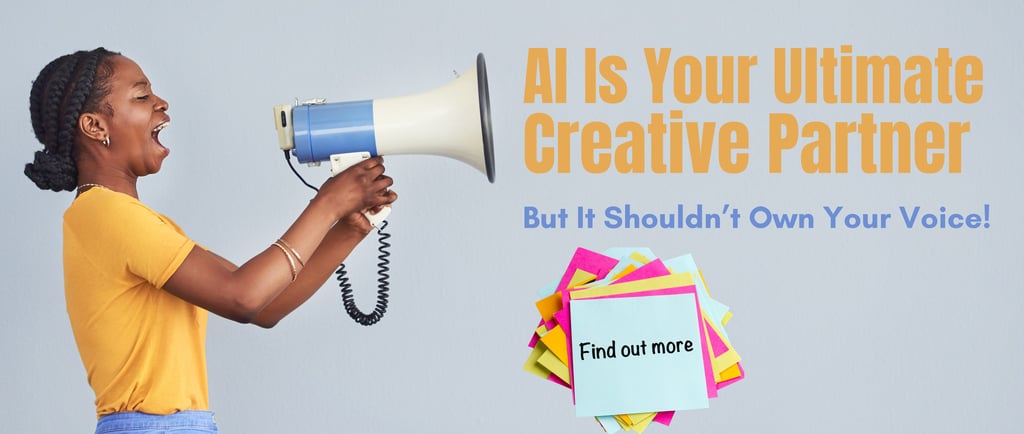
AI Is Your Ultimate Creative Partner
AI is and can be your ultimate creative partner but it should not own your voice or be considered a respectable replacement for you!
CONTENT STRATEGY & STORYTELLINGLEADERSHIP & INFLUENCE
Serena Holmes
2/13/20263 min read
A year ago, using AI for content felt like a quiet advantage. Something you experimented with late at night, half curious and half skeptical.
Now it is everywhere.
CEOs are drafting LinkedIn posts with it.
Realtors are writing listing descriptions with it.
Founders are outlining entire podcasts, newsletters, and sales pages before their second coffee.
And here is the honest truth.
AI is not going away.
But neither is the need for a real human voice.
The danger is not that AI will replace creators.
The danger is that too many people will start sounding exactly the same.
AI Is Not the Threat
Sameness Is
AI is extraordinary at pattern recognition. It understands what has worked historically and recreates it at scale. That is why so much content suddenly feels polished but hollow. It is technically correct. Structurally sound. Emotionally flat.
If you scroll LinkedIn long enough, you start noticing it.
The same hooks.
The same rhythm.
The same motivational language that says a lot without actually saying anything.
That is not a technology problem.
That is a leadership problem.
Because voice does not come from structure. It comes from lived experience, opinions formed through friction, and stories earned the hard way.
AI can help you shape your message.
It cannot decide what matters to you.
Your Voice Is Your Competitive Advantage
In a world where content is infinite, trust becomes scarce.
People do not follow you because your formatting is good. They follow you because they recognize themselves in your story, your values, your decisions, and sometimes even your doubts.
Your voice is shaped by moments like:
• Deals that went sideways
• Risks that kept you up at night
• Decisions that cost you money but bought you wisdom
• Conversations that changed how you see your industry
None of that lives inside a prompt.
This is why the strongest personal brands are not the most optimized. They are the most recognizable.
You could remove the name from the post and still know exactly who wrote it.
That is the goal.
Where AI Actually Shines
Used well, AI is not a replacement for creativity. It is a multiplier.
Think of it as your creative operations partner.
AI is excellent for:
• Breaking through blank page paralysis
• Organizing scattered ideas into clear structure
• Turning long form thinking into short form assets
• Repurposing content across platforms
• Helping you test angles faster
It saves time.
It reduces friction.
It removes excuses.
What it should not do is decide your message for you.
The Shift Every Creator Needs to Make
The most powerful way to use AI is this.
You lead with thinking.
AI helps with execution.
Not the other way around.
Before you open ChatGPT, you should already know:
• What you actually believe about the topic
• What experience shaped that belief
• Who you are speaking to
• Why this matters right now
When you skip that step, AI fills the gap with generic insight. And generic insight is invisible.
This is especially important for founders, investors, executives, and creators who are building trust based brands.
Your audience is not buying content.
They are buying confidence in your judgment.
Why Human Perspective Is Becoming More Valuable Not Less
Here is the irony no one talks about.
The more AI generated content exists, the more valuable human insight becomes.
As automation increases, differentiation shifts upstream. It moves from execution to perspective.
Anyone can generate a post.
Very few people can articulate why something matters, what it cost to learn, and how it applies in the real world.
This is why opinionated content is outperforming neutral content.
This is why personal stories travel further than generic advice.
This is why behind the scenes thinking builds more trust than polished thought leadership.
People want to know how you think, not just what you know.
A Practical Framework for Using AI Without Losing Your Voice
If you want to use AI and still sound like yourself, use this simple filter.
Before publishing anything, ask:
• Could this have been written by anyone
• Does this reflect my lived experience
• Would my clients recognize this as mine
• Does this take a stand or play it safe
If the answer feels soft or interchangeable, the work is not done.
AI should get you to eighty percent faster.
You should own the final twenty percent.
That final layer is where voice lives.
The Brands That Will Win in the Next Five Years
Speculation ahead, but this is a bet I am confident in.
The next generation of trusted brands will not be the loudest or most automated. They will be the clearest.
Clear values.
Clear point of view.
Clear line between automation and authenticity.
The winners will be people who use AI to amplify their thinking, not replace it. People who treat technology as leverage, not identity.
Because when everyone has access to the same tools, the only thing that truly differentiates you is how you see the world.
And no algorithm can replicate that.
AI Is An Incredible Creative Partner but It Should NEVER Own Your Voice!
Your voice is built through risk, reflection, failure, curiosity, and conviction. It is earned over time. It evolves. It deepens. It becomes your signature.
Use AI to move faster.
Use your voice to move people.
That is the balance.
And in a world full of noise, it is the people who sound unmistakably human who will be remembered.